|
|

Capybara: The World’s Largest Rodent (Super Sized!)
by Natalie Lunis
Book Type: Juvenile, non-fiction (ages 4 -8)
Date of publication: 2009
Publisher: Bearport Publishing
Synopsis:
Topics covered include:
- A Really Big Rodent
- Wet, Grassy Homes
- Big Teeth
- Noisy Groups
- Bringing Up Babies
- Extra-Large Enemies
- Everybody into the Water!
- Sneaky Swimmers
- Rodent Ranches
The book’s format is that each left-hand page contains up to about 80 words of text and one to three small photos with the opposing page having a single large photo on the same topic.
 Interior page of Capybaras: The World's Largest Rodent
Owner’s Review: 
This book is more for the lower end of the age range rather than the higher. The text is informative, as far as it goes, which is not very far. All of the data is correct, the layout is nice and the photos are wonderful. In fact, I’d buy it for the photos alone. But I don’t think the text is entertaining enough for very young and it is not informative enough for the older children.
Caplin’s Review:
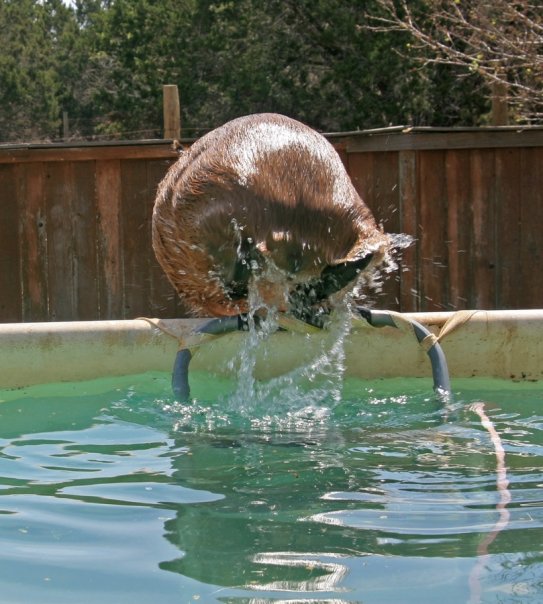
I liked this book. As my owner said, the photos are really great! There is one of a capybara jumping into the water that is just the perfect action shot. The photo of the jaguar looked just as fierce and terrifying as those awful cats really are. And photos of the baby capys with their moms were so sweet. I also liked the way the little facts were framed in capybara fur. There wasn’t much text but what it said was a pretty good description of us capybaras.

The World’s Oddest and Most Wonderful Mammals, Insects, Birds and Plants: Of Kinkajous, Capybaras, Horned Beetles, Seladangs
by Jeanne K. Hanson and Deane Morrison
Book Type: Non-fiction, general knowledge
Date of publication: 1997
Publisher: Konecky & Konecky
Synopsis:
This book covers a wide variety of living things, more than are mentioned in the title since it mysteriously omits reptiles. Most entries have about a page of text and cover the topic at a superficial level. I imagine it’s intention is just to instill a sense of wonder and curiosity in the reader and to encourage them to learm more about the entries the like the best. Some of topics are:
- How to choke a tree – about strangler figs
- Insect impersonators – about orchids that mimic insects
- The barking pika – about a cute little lagomorph that barks
- An artichoke on legs – about pangolins
- Can black widow spiders and trantulas actually kill you?
- The smartest birds – about ravens
This is just a tiny fraction of the topics.
Owner’s Review: 
This book certainly has its interesting points. And the breadth of the topics covered is amazing. But there is no depth to anything so if you’re pretty familiar with biology and wildlife, there won’t be a lot in here for you. I think it is probably best for a middle-school child with an interest in biology. Some of the topics are covered more than once, but if you’re just randomly skimming and stopping at what interests you, that’s probably not an issue.
I wouldn’t trust this book as a definitive source of information however. The section on kangaroo rats contains the following quote, “Like all other rodents, it has sweat glands only on its toe pads…” Well, Caplin is a rodent and I can tell you that he sweats a lot, and not just from his toes. When he sleeps under the covers on warm nights, there is sometimes a little puddle of water. And not a few people have commented that his back is wet from sweating when we take him out in public on a hot day.
One thing I found annoying is that the titles of the sections do not mention the name of the animal. For example, what the heck is a seladang? Can I find out about it by reading Fantastic Sharks, The Most Dangerous Flower, Astounding Hibernations or none of the above? And there is no index. Luckily the capybara blurb is titled The World’s Largest Rodent, but if I didn’t know what a capybara was, that wouldn’t help.
Caplin’s Review:
I liked this book. There was all kinds of stuff I didn’t know. Beetles can have horns? Wow! And a seladang is a fancy name for a type of cow! Who knew that? Not me. Plus plants can disguise themselves to look like insects. I am glad they can’t make themselves look like capybaras! On the other hand, maybe that would be cool.
I especially liked the part about capybaras. It was less than a page, which was a bit disappointing, but there was this cute capybara drawing.
 Illustrations by Glenn Wolff
That’s not a bad likeness of us. But the thing I liked best about the capybara entry was that it said that our sound is a “tweedle-tweet.” My owner never says I make that sound but I do. And anyway, it is that way Bill Peet described the sounds that Capyboppy made and Capyboppy is my hero.
 Emily & Elizabeth with Balloon Capybara
I have some of the most amazing friends in the world…and they’re not even all capybaras! I’d like you to meet two special friends, Emily and Elizabeth. Sure, they are cute human kids and we have that cute thing in common, but we also share another special attribute.
Elizabeth & Emily also have their own book! Seriously! (Probably their mom takes credit for their book just the way my owner takes credit for mine. That is lame.)
Did you notice what they are holding in the photo? It is a balloon capybara! Sadly, it turns out that capybaras are very hard to render in balloon. I think they did a pretty good job though. I especially like the color they chose. But the picture should give you a hint as to what their book is about. It is a instruction guide on how to make balloon animals. Who wouldn’t want to do that?
You can read more about them, their book and their fun encounters with everyone’s favorite capybara (me) on their blog. The title of their book is Kids Show Kids How to Make Balloon Animals. It’s a great idea for children’s parties and other events.
I think it would be fun if y’all would try to beat Emily & Elizabeth’s capybara-balloon rendition and send me photos of your creations. I’ll add the photos to this post. Come on! Let’s see how creative my fans can be.
Capybaras: A Natural History of the World’s Largest Rodent by Rexford D. Lord
Book Type: Technical, Natural History
Date of Publication: 07/2009
Publisher: Johns Hopkins University Press

Synopsis:
This is a technical book requiring the reader to have a general familiarity with biological concepts and techniques as well as a familiarity with anatomy. The chapters are:
- General Characteristics of the Capybara
- Anatomy and Physiology
- Natural History, Ecology and Behavior
- Diseases, Parasites and Hazards
- Census and Population
- Conservation and Management
- Case History: A 10-year Population Study
The entire book, including appendicies, is 159 pages, although the pages with color plates are not counted.
Owner’s Review:
Since I have a degree in biochemistry and have done graduate work in biology, I have the appropriate background to understand and interpret the technical data in this book. But still, I was surprised by the amount of actual data verses meaningful analysis. And many of the points are repeated in several chapters, giving the already thin volume an air of desperation to fill its pages.
I did learn several interesting facts. I learned that the smaller capybaras in Panama and Colombia are actually considered a separate species, making two capybara species rather than one. I also did not know the extent to which capybara populations have plummeted through most of their range due to overhunting. Some of the information on predation and disease was also interesting but much of the disease section was inconclusive and probably wouldn’t even be of much interest to a vet.
Much of the book focuses on capybara management in the llanos of Venezuela. Of interest in these sections was the large number, and large percentage, of capybaras “harvested” each year. But most of this would be useful only to a rancher in that region.
The photographs are interesting but not the striking images I would expect someone who had spent 10 years studying these animals to have taken. The cover photo is a good example of this. It’s not a bad photo but it is not a great one either.
On the whole, the book was a bit of a disappointment, especially as there is so little information about these animals available.
Caplin’s Review: 
Reading this book made me so glad I am a pet capybara and not one living in the wild or on a ranch. Apparently, the life expectancy of a capybara on an Hato in Venezuela is only 1.5 years! And those are the capybaras that have it easy! The photograph of a baby capy being sprited away by a caracara was especially disturbing. And the story about a male capybara randomly picking up a baby with his teeth and killing it! How horrible is that?
He did cover some of our nicer aspects though. Mother capybaras will nurse any young in their band, not just their own babies. Capybaras form a protective circle around the young to protect them when threatened. And he mentioned what excellent swimmers we are.
I didn’t even bother to look at any of the charts ortables of data though. That stuff bores me. I have to rely on my owner to tell me if there’s anything important there.
Hooway for Wodney Wat by Helen Lester illustrated by Lynn Munsinger
Houghton Mifflin Company, Houston
Copyright 1999
Ages: preschool – grade 2

Synopsis:
Wodney Wat is a shy rat who cannot pronounce his r’s, a serious affliction for a rodent. His classmates in an elementary school attended apparently by only rats but taught by a guinea pig, make fun of him so Wodney (actually Rodney in case you didn’t get it), almost never speaks. One day a new rodent joins the class, Camilla Capybara, who is large and smart but also aggressive and careless toward the lesser rodents. Wodney and his classmates are all scared and jealous of Camilla, and like most youngsters, they dislike her because of her differences. When the young rats and Camilla go outside for recess, Wodney is inexplicably chosen (you’ll remember his classmates don’t like him either) to lead the game of Simon Says. Wodney mispronounces everything, for example saying “Wake the leaves” instead of “Rake the leaves.” The other kids all understand him because they know about Wodney’s problem but poor Camilla Capybara takes him literally. When Wodney tells everyone to “go west,” Camilla heads off in the sunset never to be seen again. This makes Wodney the class hero.
Owner’s Review: 
I think the message of this book is that some differences should be tolerated (Rodney’s speech impediment) while others should not (Camilla’s size and the fact that she is a different species). I don’t think this is the book’s intent but it can certainly be read that way and a fair percentage of readers are bound to see it, even if only subconsciously.
Another thing I disliked about this book was that it doesn’t show Rodney striving to overcome his speech problem. My son had this exact problem when he was the age of the average reader of this book and through hard work and speech therapy, he learned to pronounce his r’s correctly. Obviously not all disabilities are treatable, for instance my husband is a paraplegic and we find it really annoying when people say you can overcome that type of injury by trying harder. But this is one disability that can be corrected if treated early enough and that message is totally missing from this book.
Caplin’s Review: 
I got so excited when my owner said we were going to read a picture book about a capybara! I love pictures and I love capybaras, what could be better (besides yogurt)? But why did the rats pick on that poor little capybara? She was at a new school, just trying to make friends. It’s always hard when you don’t know anyone and everyone else is friends with everyone else and they won’t even talk to you. Especially if you’re a little different like Camilla was in this story. Maybe she just knocked those kdis over because we capybaras have our eyes on the sides of our heads so be don’t have binocular vision.
And the illustrator drew Camilla as big and ugly and the rats as cute and small. I can’t help how big we are. And anyway, plenty of people think I’m cute. Do you really have to be small to be cute? At the end of the book I had to wipe the tears out of my eyes as my poor cousin walks off and is never seen again while all the little rats celebrate. I hope Camilla found her way home and I don’t blame her for never going back to that school.
|
|