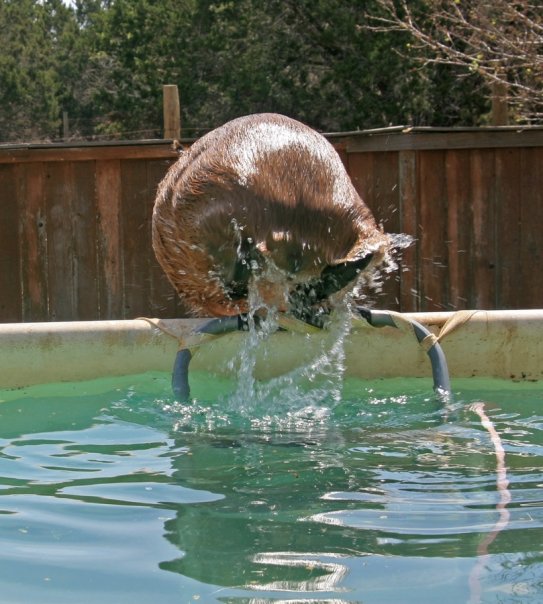
Life With a Capybara

Owner’s blog:

2008_03_29_26_CaplinDay

Morning capybara!

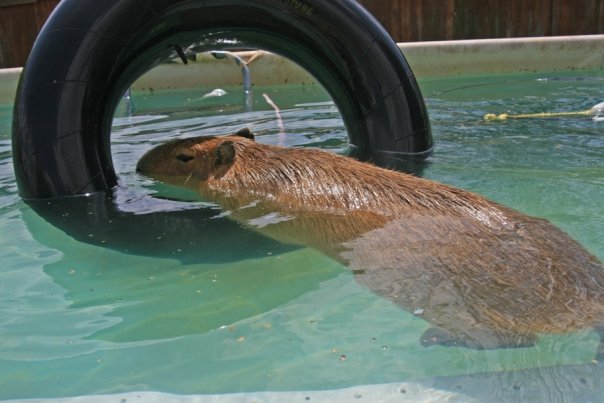
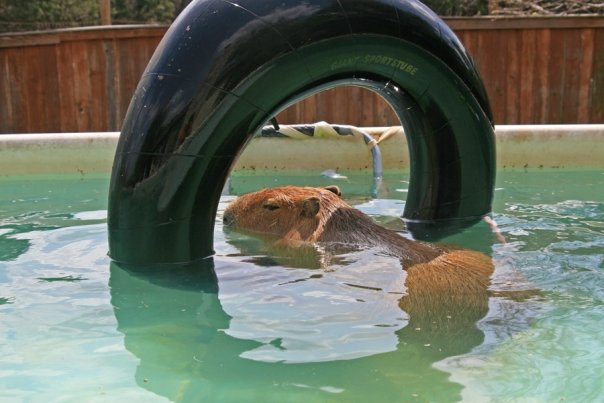
Morning comes early at my house. Weekends or weekdays, a certain capybara named Caplin Rous wants his morning yogurt. He has various ways of making this known. The most subtle wake up is one where he sits on the floor or lies on the bed and eeps periodically. Eeping is that I call the soft, high-pitched noise he makes when he wants something. Guinea pigs call this a wheek. It sounds something like a one-note bird call. To wake me he’ll eep quietly, wait thirty seconds or so and eep again just loudly enough to keep me awake. As far as I know, he can keep it up forever.

Another wake-up tactic is to tap me on the face. This is not subtle at all. He comes out from under the covers, climbs onto my pillow with his face directly above mine and not-so-gently taps me on the nose or the cheek or even on the eye or mouth with his large, heavy paw. Sometimes I try to hide under the pillow but this is no good since his 100 lb weight it holding it down.

Might as well get up.

Continue reading "Life With a Capybara" »

Venezuela Hates Capybaras

Capybara family at Hato El Frio, Venezuela

Capybara family at Hato El Frio, Venezuela

(Owner’s Blog)

In Febrary of 2007, my kids (Coral & Philip Waters) and I went to Venezuela. One of the places we went was a large ranch called Hato El Frio in the Los Llanos region. Los Llanos is often reffered to as the New World equivalent of the African plains. Such a tremendous abundance of wildlife! And among those swamps and plains roam the world’s largest rodents, the capybaras.

Capybaras have disappeared in parts of their range where they are over-hunted or where there has been significant habitat destruction due to farming, daming and deforestation. Hato El Frio was one place where they still occurred in large number due to the ranche’s progressive attitudes.

Hato El Frio (and Hato El Cedral, although I did not visit there) were experiments in sustainable ranching along with ecotourism. Dams were built to encourage wildlife to remain year-round and to provide more habitat for aquatic or semi-aquatic species. In addition, cattle and water buffalo were raised for meat. Capybaras were also “harvested” but in a sustainable manner. For decades the ranch maintained a science station that studied the affects of ranching on wildlife populations.

The following photos show some of the interesting animals that we saw on our week-long stay.

Tamandua or Lesser Anteater at Hato El Frio, Venezuela

Tamandua or Lesser Anteater at Hato El Frio, Venezuela

Giant Anteater at Hato El Frio, Venezuela

Giant Anteater at Hato El Frio, Venezuela

Rufous-tailed Jacamar at Hato El Frio, Venezuela

Rufous-tailed Jacamar at Hato El Frio, Venezuela

Three species of Ibis at Hato El Frio, Venezuela

Three species of Ibis at Hato El Frio, Venezuela

Scarlet Macaws Flying at Hato El Frio, Venezuela

Scarlet Macaws Flying at Hato El Frio, Venezuela

Howler Monkey at Hato El Frio, Venezuela

Howler Monkey at Hato El Frio, Venezuela

I could go on but you are probably wondering what the point is. So let me get to it. The Venezuelan government, under Hugo Chavez, has nationalized Hato El Frio and Hato El Cedral. See this article, Venezuela Coverts Tourist Destination into Farm Land.

I doubt that they are even now maintaining the Hatos’ programs to rebuild populations of the seriously endangered Orinoco crododile, red-footed tortoises, Orinoco side-neck turtles or river dolphins. I doubt that they are concerning themselves with sustainability. These ranches have served as a beacon to the region as to what can be done to use the land while retaining wildlife. Now all of that is gone.

This is a terrible tragedy made even worse by the fact that most Americans–who live so close–don’t even know what the world is losing. Most Americans don’t even know what a capybara is. Caplin and I are devastated. No species is safe if people and governments don’t care.

(Follow this link to see more of my photos of Hato El Frio including more capybara photos.)

Georgetown Book Festival

Owner’s Blog

Table display for Celeste and the Giant Hamster

Table display for Celeste and the Giant Hamster

As hard as it was to pull myself away from Caplin for a whole day, I spent this past Saturday at a book festival in Georgetown, Texas. It’s coming up on the holiday season and it seemed like a good idea to get Celeste and the Giant Hamster out in the public eye. This is the first book festival I’ve ever attended, either as an author/participant or as library patron, even though I am an avid reader. I paid my twenty bucks and got my own table, shown above.

Sadly, the book festival people refused to allow Caplin to come, even for an hour or so, to entertain the festival goers. That was a mistake on their part because Caplin would have really livened up the place! Instead I had to use some stand-up cut-outs of him as surrogate capybaras. (I got the standups made at PartyStandups.com. If you’d like a Caplin standup, drop me a comment and let me know what photo you’re going to use so I can send you the full resolution image.)

The real Human Celeste and the fake Caplin Rous

The real Human Celeste and the fake Caplin Rous

That worked out okay but what I didn’t realize is that I should have marked each of the three stand-ups–one of baby Caplin, one of Caplin at four months and one of adult Caplin–as all being life-sized. Instead I had to tell everyone that when they came up to my desk. Maybe that actually worked better because it was fun to see their expressions of astonishment. (Although they would have been even more astonished by the real Caplin Rous.)

Celeste, my granddaughter and the impetus for writing the book, came and spent a little time with me. But mostly she went to the other book festival activities like the magic show and story-telling. She and the other kids seemed to have a great time. But the meet-the-authors part of the festival was tucked away in a room upstairs and there were no activities up there. For example, a live capybara activity would have been great. Or they could have just had short book-readings. Or they could have had authors talking to kids about what it is like to write.

But, alas, the meet-the-authors section was not well attended. Nevertheless, I had a great time. I met some interesting people, gave out a lot of cards for this blog, talked about capybaras to everyone, and had interesting discussions with some of my fellow authors.

I also gave away many copies of the capybara coloring pages and some kids even colored them at my table (I colored two myself!). If you colored one of the pages, please send me a scan of it to post here, you can use the Contact tab on the left sidebar. It would be great to see your artistic endeavors.

2009_11_14_05_sGeorgetownLibrary

The Meet-the-Authors room at the book festival.

And I learned that Georgetown, Texas has a totally awesome library. It has wonderful open stacks, great art in the hallways and sculpture outside, an actual café in the library with great food. But the best part is the children’s section. It has a South American jungle theme with murals painted on all the walls.

Mural including a capybara in children's section of Georgetown library

Mural including a capybara in children's section of Georgetown library

Please notice the capybara peeking out of the grass near the bottom left corner. How great is that? Of course, whoever painted it had no idea how large capybaras are because that one would be a midget. Or maybe the jaguar is a giant. Or maybe nothing is drawn to scale. At any rate, I would love to do a book reading / capybara encounter and have Caplin in front of that mural. I donated a copy of the book to the library and gave them one of Caplin’s cards. Hopefully they’ll contact me about it.

Ten, Count Them, Ten! Baby Capybaras!

(Owner’s post)

Mother capybara with 5-day-old babies

Mother capybara with 5-day-old babies

Last weekend I had the chance to visit a local capybara owner who had two capys give birth on the same day. The ten babies were just five days old when I visited and it’s hard to imagine anything cuter. I just have to share the photos with all of Caplin’s fans.

These babies will be offered for sale in a few weeks and, no, we are not getting a second capybara! If you contact me, I can send your email to their owner. PLEASE read the FACute and the post on When Capybaras Bite before considering getting a pet capybara. They are always incredibly cute but they are large animals and they do not have the tolerance of a dog or a cat.

Five-day-old capybara

Five-day-old capybara

Five-day-old baby capybara

Five-day-old baby capybara

The proud (but mud-covered) father

The proud (but mud-covered) father

Babybara with Carl

Babybara with Carl

These guys were really eepy but the parents didn’t seem to get upset about it. I don’t know why Coral and Carl, who visited with me, felt they had to put food on its head. This may well have been this little capy’s first solid food.

Babybara nose-taps

Babybara nose-taps

Wish I could post all my photos but this will have to do.

Feeding Frenzy

Owners blog:

Sharks may be better known for their feeding frenzies but that is just because people don’t know Caplin Rous!

To say Caplin has favorite foods is putting it mildly. There are some things he just goes wild for and one of those foods is the hard, crisp, green pears that some people grow here in central Texas.

Squirrel with Pear on our back fence

Squirrel with Pear on our back fence

Normally, Caplin is very gentle when he takes food from my hand. His little lips are soft, downy and sensitive. He lifts each blueberry with delicate ease from the tips of my fingers.

Pears are a different story. They are big enough that he has to bite into them and they are very hard. At least the ones he likes are hard. He doesn’t like the soft, juicy ones from the grocery store. I’ve feed him hundreds of pears these past two years and never had a problem…until yesterday.

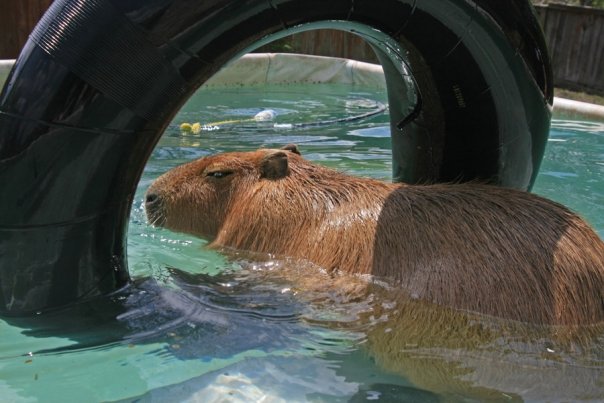
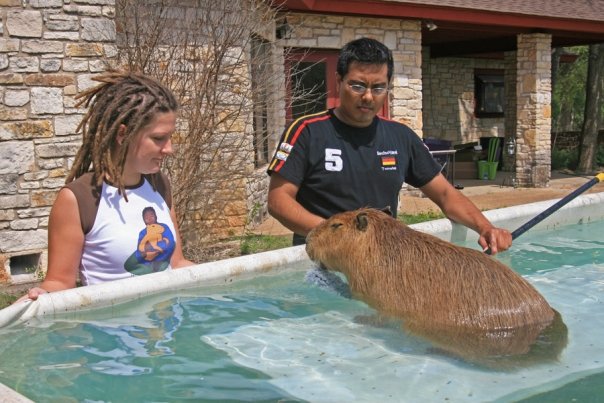
I was feeding Caplin a pear as he sat on his pool table and I squatted in the warm water beside him. From that angle, I can see his huge teeth chomp into the crispy fruit and think about how those teeth are constantly chipping to keep their sharp edge. I imagine the pears are a good sharpening tool for them. And so I was watching him eat, shifting the pear in my hand so his teeth could find easier purchase when…OUCH! The tip of my thumb had accidently slid into his mouth. He didn’t actually bite down hard on it, but he did bring some pressure to bear.

14 hours post-injury

14 hours post-injury

The pain was immediate and tremendous. Blood spurted from the wound. I grabbed my thumb with my other hand and pressed the flesh back together as hard as I could tolerate. Caplin looked down at me with an innocent air. I shifted the pear to my fingers and let him have the last couple of bites.

My thumb throbbed as I got out of the pool. I sat on the picnic table, afraid to remove the pressure for fear that a slice of flesh might peal off. Caplin eeped. More treats? No? He got out to graze as I watched him and pondered my options.

Fact is, I don’t want to go to a doctor with a wound like that and say my capybara bit me. I’m a little paranoid. What if they think he might have rabbies? I know he doesn’t. It was a simple accident. What if he gets reported as a dangerous animal. He isn’t.

I waited 20 minutes and then went into the house. When I released the pressure, blood oozed from around the edges of the injury but, aside from the pain, it didn’t seem that bad. I tore off a strip of vet wrap that I always keep around in case of horse emergencies, and wrapped my thumb.

14 hours post-injury

14 hours post-injury

It’s now 24 hours later. The thumb still hurts but not nearly so much. I can even use it to type this post (only the space key of course, and mostly I use my left thumb for that). So it looks like I got off easy. I fed him another pear tonight, being extra careful.

Lesson: Never underestimate the sharpness of rodent teeth.