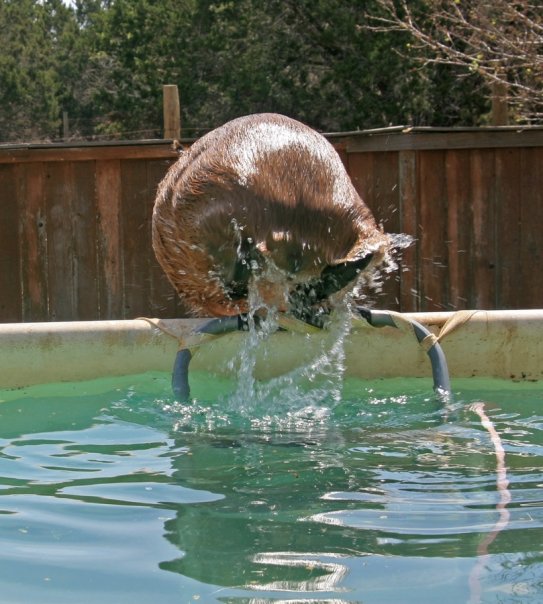
The Elusive Lesser Capybara Part II

Owner’s blog:

Lesser Capybara at Gamboa, Panama (photo by Jose Soto)

The amazing photo above is of the elusive lesser capybara. The lesser capybara, Hydrochoerus isthmius, is a second species of capybara found only in Panama and Colombia. And guess what? We are going to go see them!

Continue reading “The Elusive Lesser Capybara Part II” »

Baby caybaras are too cute for words

Capy Trio Rocks Chessington Zoo

If you are in the UK you must go see these three adorable capybara babies as the Chessington Zoo! And follow this link for more adorable photos on ZooBorns.com.

Meet Noah, Spokescapy for Toyota

Hi everybody who is supposed to be a capybara lover,

My name is Noah, a boy capybara residing in Japan. I’ve just debuted as a Toyota car commercial film character, playing a pet capybara of a Japanese family which owns the car. The car is the Toyota Noah—but I’ve not got any reimbursement from Toyota and I have nothing to do with selling this car to you—I’m not being bribed.

Check this out!

http://toyota.vo.llnwd.net/e1/toyota/noah/index.html

Oops, of course, it’s written in Japanese, which I understand perfectly. For the people who have a problem with Japanese, I’ll try to explain the Website page by page in English.

When you get in the URL above, you’ll see me sitting in my room with a laptop computer. Please come in, but make sure you take off your shoes before entering my house. It’s a Japanese custom to separate outside and inside by taking the shoes on and off. You’ll notice that my room is in typical Japanese style—I can sit on the floor that is covered with tatami mats, which are made of straw-like plants…you can tell that I’d really love that! At the right corner of the room, I laid my futon and pillow folded neatly. Japanese people unfold this kind of futon on the tatami mats when they sleep. It’s kind of nice as we can save space compared to the case in which we use a bed. Formally, the futon is supposed to be stored back in the closet to its right. That way, the space is absolutely empty during the day. The doors to the closet are sliding doors, which are also space-saving. The table is really low, which is suitable for those sitting on the yellow sitting pillows on the floor (called zabuton, which means “sitting futon”) while drinking green tea from the tea pot and cup on the table. You can notice that somebody is hiding in the closet and making noise—that is a famous baseball coach, who actually did my voice this time.

If you drag the mouse onto me, there is a caption says “click here and there in my room” and you can do it. There are 7 places that you can click: #1 the calendar, #2 the TV, #3 the radio, #4 the books, #5 the computer, #6 the window and the last, #7 the sliding door.

First, click the calendar for today’s twittering—I twitter on things every day, so if you click on a certain day on the calendar, you will play a video with my twitter for that day. Sorry, that is in Japanese and it’s too much to translate so I will skip this…

Second, click the TV, which shows you the making of the TV commercial in which I am featured, in four parts. The upper left part is how I observe my owner’s family; in the video I am pushing the busy family to go on a trip by giving them the car key. The upper right shows how I acted during the making of the commercial. The lower left is an interview with the actress who played the mother in the family. The lower right is an interview with a baseball coach who did my voice.

Third, click the radio, which plays a radio commercial with my voice.

Fourth, click the books, and my profile will be displayed. To the left there are my pictures, which can be displayed in larger form by clicking on the thumbnails. To the right is my detailed profile. For the people who don’t understand Japanese, I will try to translate. It says that my age is a secret, my gender is male, and my profession is a commercial film character named Noah. It also says that: my hobbies are bathing in a hot spring and feng shui; my talent is twittering; my favorite thing is going out on the weekend; and my voice is played by the coach of a famous professional baseball team. The pentagon is an analysis of my character. From the top of the pentagon and clockwise are: level of preference for the outdoors; promptness; obesity; sense of humor; and degree of wicked tongue. You can tell the degree of each by the number.

Fifth, click the computer, and you will see and hear the mother of the family explaining why the mother of the family decided to buy the Noah (the car, not the capybara). You need a Flash player for this.

Six, click the window, and there will be a page in which you can enter text to boast about your family, your Toyota Noah, etc. If this is well written, you have a chance to get a stuffed capybara character, Kapibara-san, from Toyota. However, this is mostly for Japanese users.

Seven, the sliding door will show you the famous baseball coach—Katsuya Nomura—who did my voice, as I told you above.

(Thanks to Chie Gough, who translates Capybara Madness into Japanese, for conducting this wonderful interview with Noah Capybara!)

(PS: I wonder how I can become the US Spokescapy?)

(PPS: I think Noah is going to steal my title of “World’s Most Famous Capybara.” I guess I’m okay with that.)

(PPPS: Even though Noah says his name is a secret, I estimate he is about four months old. Those who read this blog can probably make a similar estimation based on Noah’s apparent weight and the fact that his nose is very pink.)

Update on Blancanieves

Blancanieves exploring with her brother

Blancanieves exploring with her brother

Some of you may recall my post about a baby white capybara born on Christmas day. I said she was born in Bolivia but that was not true.  She was actually born at M’Bopicuá Breeding Station in Uruguay.  Her caretaker,  Juan Villalba-Macias, wrote me and explained my mistake. He also told me she is doing great and he sent some photos of her for me to share with my readers (after the break).

Continue reading “Update on Blancanieves” »

Venezuela Hates Capybaras


Capybara family at Hato El Frio, Venezuela

Capybara family at Hato El Frio, Venezuela

(Owner’s Blog)

In Febrary of 2007, my kids (Coral & Philip Waters) and I went to Venezuela. One of the places we went was a large ranch called Hato El Frio in the Los Llanos region. Los Llanos is often reffered to as the New World equivalent of the African plains. Such a tremendous abundance of wildlife! And among those swamps and plains roam the world’s largest rodents, the capybaras.

Capybaras have disappeared in parts of their range where they are over-hunted or where there has been significant habitat destruction due to farming, daming and deforestation. Hato El Frio was one place where they still occurred in large number due to the ranche’s progressive attitudes.

Hato El Frio (and Hato El Cedral, although I did not visit there) were experiments in sustainable ranching along with ecotourism. Dams were built to encourage wildlife to remain year-round and to provide more habitat for aquatic or semi-aquatic species. In addition, cattle and water buffalo were raised for meat. Capybaras were also “harvested” but in a sustainable manner. For decades the ranch maintained a science station that studied the affects of ranching on wildlife populations.

The following photos show some of the interesting animals that we saw on our week-long stay.

Tamandua or Lesser Anteater at Hato El Frio, Venezuela

Tamandua or Lesser Anteater at Hato El Frio, Venezuela

Giant Anteater at Hato El Frio, Venezuela

Giant Anteater at Hato El Frio, Venezuela

Rufous-tailed Jacamar at Hato El Frio, Venezuela

Rufous-tailed Jacamar at Hato El Frio, Venezuela

Three species of Ibis at Hato El Frio, Venezuela

Three species of Ibis at Hato El Frio, Venezuela

Scarlet Macaws Flying at Hato El Frio, Venezuela

Scarlet Macaws Flying at Hato El Frio, Venezuela

Howler Monkey at Hato El Frio, Venezuela

Howler Monkey at Hato El Frio, Venezuela

I could go on but you are probably wondering what the point is. So let me get to it. The Venezuelan government, under Hugo Chavez, has nationalized Hato El Frio and Hato El Cedral. See this article, Venezuela Coverts Tourist Destination into Farm Land.

I doubt that they are even now maintaining the Hatos’ programs to rebuild populations of the seriously endangered Orinoco crocodile, red-footed tortoises, Orinoco side-neck turtles or river dolphins. I doubt that they are concerning themselves with sustainability. These ranches have served as a beacon to the region as to what can be done to use the land while retaining wildlife. Now all of that is gone.

This is a terrible tragedy made even worse by the fact that most Americans–who live so close–don’t even know what the world is losing. Most Americans don’t even know what a capybara is. Caplin and I are devastated. No species is safe if people and governments don’t care.

(Follow this link to see more of my photos of Hato El Frio including more capybara photos.)